
Two Separate Aid and Attendance Awards: How We Won SMC-R1 for a Vietnam Veteran

1st Infantry Division holding a Vietnamese child in 1967
Last year, I was scrolling through a Veteran forum on Reddit, something I like to do when I have a few spare minutes. I’ll jump on there, see what questions people are asking, and if I can help someone, I try to do so. That’s how I came across a post from the daughter of a Vietnam-era Veteran who was looking for help for her father, who we’ll call “Dirk.” He was seriously ill, she was his fiduciary, and she had been forced to quit her healthcare job so she could stay home and take care of him. She was at the end of her rope and was trying to figure out whether there was any way to keep her dad at home instead of having to put him in a care facility.
After reading her post, I thought there was a pretty good chance we could help.
Dirk had a 100% rating for PTSD, and this wasn’t a case where someone was simply having a difficult time managing his symptoms. He had multiple suicide attempts and multiple inpatient psychiatric stays. Saying that he needed full-time supervision would be a massive understatement. His daughter told me about one incident in particular that really stuck with me. She was watching the home surveillance system when she saw her father trying to drive a riding mower over and through a burning pile of brush in the backyard. Thankfully, she was able to intervene before that situation turned into an absolute disaster. It was that kind of stuff on a regular basis.

U.S. Air Force 317th Combat Control Team in chemical warfare gear during exercise Reforger/Autumn Forge - 1980
On top of the PTSD, Dirk had a 100% rating for coronary artery disease. His heart condition was severe enough that his daughter had to assist him with multiple activities of daily living. He also had diabetes, multiple diabetic complications, and a number of other service-connected conditions. In other words, this was a Veteran who clearly required a tremendous amount of care and supervision.
I reached out to his daughter, and we talked on the phone the following day. Based on everything she told me, I thought her father had a very strong case for Special Monthly Compensation, specifically SMC-R1. The basic theory was that he had two separate service-connected disabilities, and each one, standing on its own, required the regular aid and attendance of another person.
Once I got access to his VA file, I found something that made the situation even more frustrating.
They had already applied for Aid and Attendance under SMC-L within the previous year, but the VA had never actually made a decision on the claim. In fact, the VA had ordered an examination to complete a VA Form 21-2680, which is the form used to document the need for regular aid and attendance, and that examination showed that Dirk needed aid and attendance.
And then...nothing.

U.S. Army Special Forces exit a UH-60 Black Hawk
Well, not exactly nothing. This is the VA we’re talking about. They issued rating decisions on other issues after the Aid and Attendance claim had been filed, so somebody was obviously still operating the controls over at the local puzzle palace (Regional Office). They just somehow managed to completely overlook the claim for A&A.
Apparently it had fallen into the same mysterious VA black hole where common sense, accountability, and completed claims occasionally go to die.
The VA Form 21-2680 is not exactly the greatest form the VA has ever created, but when you’re dealing with an SMC claim, it is an important piece of evidence, and it needs to be completed correctly. Unfortunately, both the original form submitted by the family and the one completed through the VA were poorly done.
So we had some work to do.
The chain of command
I helped the family obtain an independent medical evaluation that specifically addressed the issue and established that Dirk required Aid and Attendance because of his PTSD alone. It also established that he required Aid and Attendance because of his coronary artery disease and diabetic complications alone.
That distinction was important.
We weren’t simply arguing that Dirk had a bunch of disabilities and therefore needed someone to take care of him. We were developing the evidence to show that each of these separate service-connected conditions, by itself, created a need for Aid and Attendance.
This is where things get fun.
And by “fun,” I mean the same way getting a root canal without anesthesia is fun.

101st Airborne soldier searching for Vietcong - Operation Van Buren 1966
If you’ve dealt with the VA for any length of time, you probably know where this is going. I had no expectation that the Regional Office was going to understand the SMC-R1 argument. In my experience, these types of SMC claims are frequently misunderstood at the Regional Office level, particularly when you start talking about separate SMC awards and the VA’s concerns about pyramiding.
At that point, we weren’t really trying to convince the Regional Office to understand the entire legal argument. That was a waste of time as they would never grant it in a thousand years. We were building the record and laying the groundwork for the appeal that I fully expected would eventually have to go to the Board of Veterans’ Appeals.
That’s because the Regional Office has its own special version of reality. You can hand them the law, the facts, the medical evidence, and a map with a big red arrow pointing directly at the answer, and sometimes they will still take a left turn into a cornfield.
So we built the case.
We filed a Supplemental Claim and submitted the independent medical evaluation as new evidence. The goal was to make sure that the evidence was in the record before the case eventually went to the Board.
The VA eventually did grant SMC-L for Aid and Attendance, so at least they finally acknowledged what the medical evidence had been showing all along. Unfortunately, they still had no idea what to do with the SMC-R1 claim, and they denied it.
Well, they had an answer.
It just wasn’t the right one.
So we went to the Board.
I immediately filed the appeal on the Direct Review docket and submitted a 14-page brief laying out the facts and the legal argument. These dual Aid and Attendance cases involve some fairly complicated legal issues, so I like to put everything on the table and draw the Board a map to the answer. The evidence, the law, and how the two fit together are all right there in front of them, leaving as little room for misunderstanding as possible. Because Dirk was seriously ill, I also filed a motion to have his case Advanced on the Docket. That motion was eventually granted, and then all we could do was sit back and wait to see what the Board would do with it.

Special Forces soldiers of the 7th Special Forces Group patrol through Helmand Province - 2007
Thankfully, we didn’t have to wait terribly long.
The Board decision came in, and SMC-R1 was granted, along with more than $65,000 in back pay.
That was one of those phone calls you actually enjoy making.
I got to call his daughter and tell her that we had won. This wasn’t just another VA rating decision that would look good in a file somewhere. This was a life-changing amount of money for a family that was trying to keep a seriously disabled Veteran at home rather than putting him into a care facility.
Before the award, Dirk had been receiving $3,938.58 per month. With the SMC-R1 award, his monthly compensation increased to $9,826.88. And all of that accomplished in less than a year.
That is a heck of a difference.
But, as anyone who has dealt with the VA knows, winning the claim doesn’t necessarily mean the fight is over.
Nope.
That would be far too easy.

101st Airborne artillerymen barrel cleaning 105 mm howitzer - Operation Wheeler 1967
Dirk’s daughter was his fiduciary, which meant there were several additional hoops she had to jump through before the VA would actually release the money. She promptly completed everything they required, and then ran straight into another bureaucratic wall.
The fiduciary side of the VA seems to have a special talent for taking something that should require about fifteen minutes and turning it into a months-long archaeological expedition.
They proceeded to sit on Dirk’s award for months.
At one point, the local fiduciary representative allegedly told his daughter that the award was so large there must have been some kind of mistake. He also reportedly told her that, as a former VSO, he didn’t believe that two awards of Aid and Attendance were possible.
I wasn’t exactly surprised by that reaction.
In fact, I got a pretty good chuckle out of it because this was precisely the misunderstanding we had been dealing with from the beginning.
Apparently, the idea of two separate Aid and Attendance awards had been filed away in the VA’s ‘we don’t do that’ department.
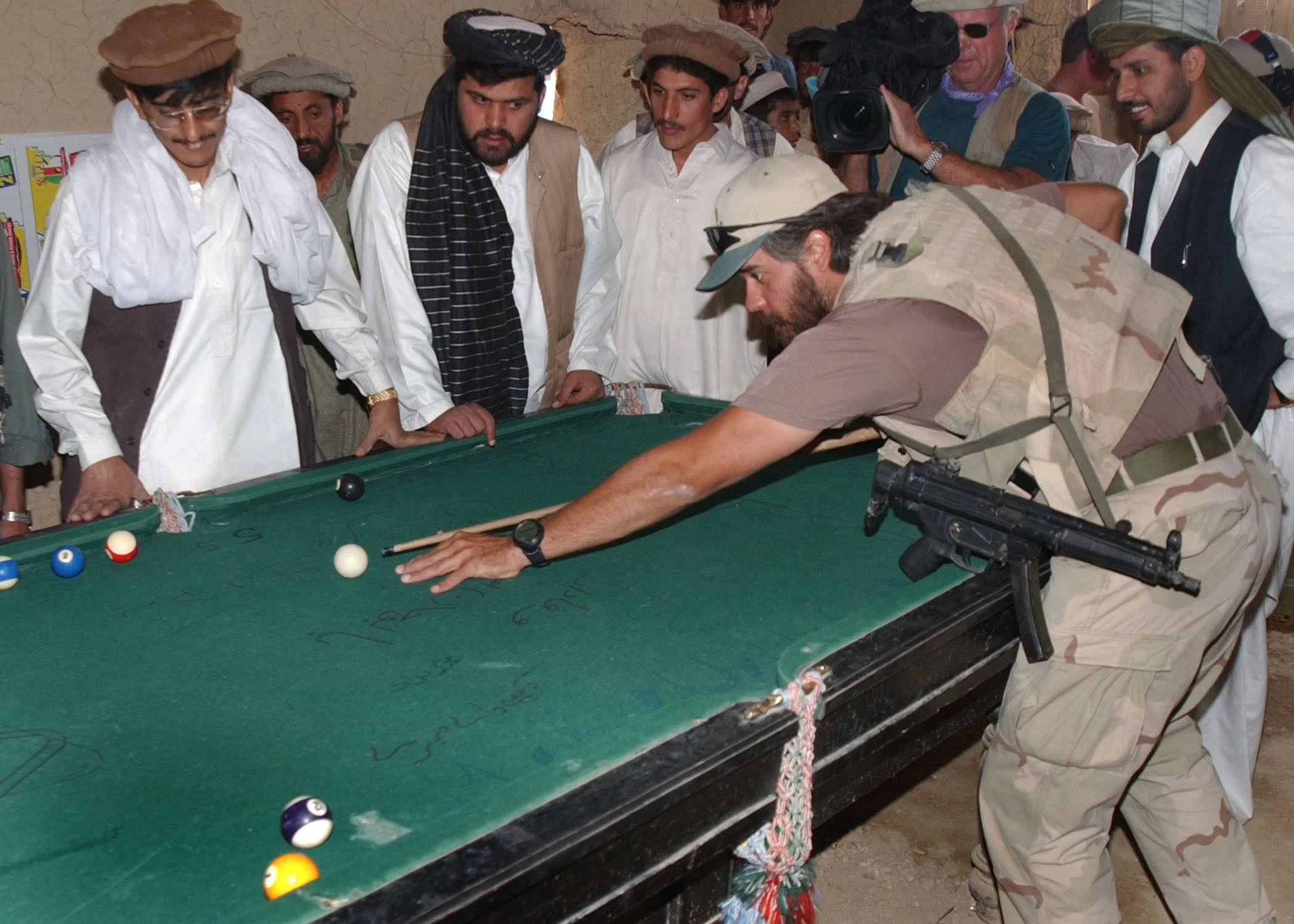
Army SF soldier plays pool - Afghanistan 2002
Eventually, our collective patience ran out, and I started making some noise on their behalf. I called and emailed the local fiduciary representative, contacted the fiduciary hub, and reached out to several higher-ups in the various VA offices that had been involved in the case.
None of this should have been necessary.
But sometimes, unfortunately, you have to make enough noise that somebody finally decides it might be easier to fix the problem than continue ignoring it.
Apparently, somebody finally got the message.
Suddenly, Dirk’s award was processed.
Imagine that.
That’s one of the most frustrating things about dealing with the VA. Sometimes you can fight all the way through an appeal, win the case, get the decision you were asking for, and then discover that you still have to fight to get the VA to actually implement the thing.
It’s like winning the Super Bowl and then discovering the trophy is sitting in the mailroom because somebody forgot to sign for it.
But we aren’t done.
Not even close.
Now we’re building the case for SMC-R2.
I won’t rest until we’ve gotten Dirk every dollar that he is legally entitled to receive. He sacrificed a tremendous amount for this country, and he and his family are living with the consequences of those sacrifices every single day.
The VA may have its puzzle palace, its black holes, its bureaucratic escape rooms, and whatever other obstacle course they decide to throw at us next.
Fine.
We’ll deal with it.
The fight continues.
If you are a Veteran and need help with your claim or appeal, you can contact me here.